
Bridging the Gap: Full Duplex IRIG 106 Chapter 7 Gateways

In flight testing, transitioning from legacy hardware to modern Ethernet-based architecture presents significant integration challenges. Telspan Data simplifies this evolution with a Multi-Disciplined, Standards-Based Approach, delivering a suite of products that serve as a high-performance bridge between traditional PCM and modern Ethernet networks.
The Power of Chapter 7 Integration
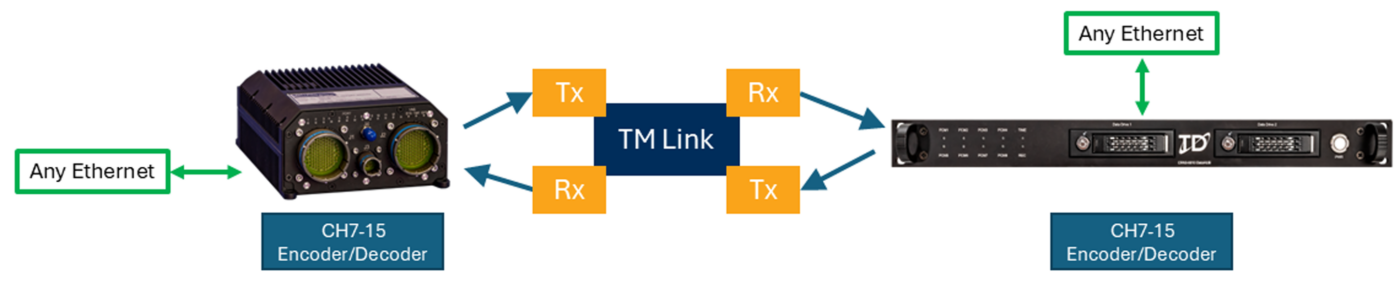
IRIG 106 Chapter 7 gateways occupy a critical position in the telemetry chain, sitting between instrumentation systems, Ethernet networks, and telemetry transmitters. Utilizing advanced FPGA processing, these units function as bi-directional translators, acting as both Ethernet-to-telemetry encoders and telemetry-to-Ethernet decoders.
The “magic” of Chapter 7 lies in its ability to utilize existing range telemetry systems. By embedding Chapter 10 packets, TmNS messages, and standard Ethernet frames within the minor frames of PCM streams, these gateways enable asynchronous packet telemetry. This streamlined approach supports mixed data types—including analog, video, and high-speed bus data—while maintaining full compatibility with legacy IRIG Chapter 4 systems.
Versatile Solutions for Ruggedized Environments
Telspan Data offers three distinct hardware tiers to meet varying mission requirements:
- Integrated Ethernet Switch (iES): More than just a switch, the iES is a comprehensive timing and processing hub. It features 16 triple-speed Ethernet ports, layer 2/3 management, a GPS receiver, and hardware-based IEEE-1588 Grand Master capability. With two 50Mbps PCM ports and full-duplex Chapter 7-15 processing, it allows for simultaneous encoding and decoding in a single footprint. Learn More
- Instrumentation Gateway Unit (iGU): Designed for high performance in a smaller footprint, the iGU combines managed switch capabilities with network timing and Chapter 7 PCM I/O. It is the ideal solution for flight test instrumentation where space is a premium but capability cannot be sacrificed. Learn More
- Micro Gateway Unit (uGU): For environments where every millimeter counts—such as missile or munitions testing—the uGU stands alone. At less than 2.5 cubic inches, it provides two 10/100 Ethernet ports, two PCM ports, and full-duplex Chapter 7 processing. Learn More
Closing the Loop: Standards-Based Ground Systems
The telemetry ecosystem is completed by the DataHUB, a comprehensive ground system designed for real-time IRIG-compliant Chapter 10 recording, publishing, and stream reconstruction. By integrating full-duplex Chapter 7 gateway functionality, the DataHUB provides ground stations with a powerful bi-directional interface between the air vehicle and the ground station. Learn More
The Advantages of Chapter 7 Integrated Hardware Design
The primary benefit of Telspan Data’s multi-disciplined approach is simplicity without compromise. By tightly integrating Ethernet switching and network timing with PCM interfaces and full-duplex IRIG 106 Chapter 7 processing into purpose-built hardware, flight test teams can modernize their telemetry architectures incrementally—without abandoning proven legacy systems.
Rather than forcing a wholesale transition to packet telemetry, Chapter 7 gateways allow Ethernet data to coexist naturally within traditional PCM links. This preserves established workflows, spectrum usage, and ground infrastructure while unlocking the flexibility of network-based instrumentation. The result is lower integration risk, reduced SWaP, and fewer points of failure compared to loosely coupled, multi-box solutions.
Equally important, full-duplex Chapter 7 capability enables true bi-directional communication. Configuration updates, timing alignment, and network management traffic can flow alongside real-time telemetry, improving situational awareness and operational agility during test events.
When paired with a standards-based ground system like DataHUB, the architecture “closes the loop”—providing seamless translation, recording, and reconstruction of telemetry streams across both PCM and Ethernet domains. Ultimately, Chapter 7 integrated hardware is more than just a bridge; it is a practical migration path that allows programs to extend the life of existing investments while moving confidently toward future telemetry architectures.
For more about our full line of standards based telemetry hardware and software solutions, visit us at telspandata.com or follow us on LinkedIn for the latest product news and event updates.